
Automated Spot Check Vital Signs Monitoring for Clinic Teams
10/30/2026 05:16:37

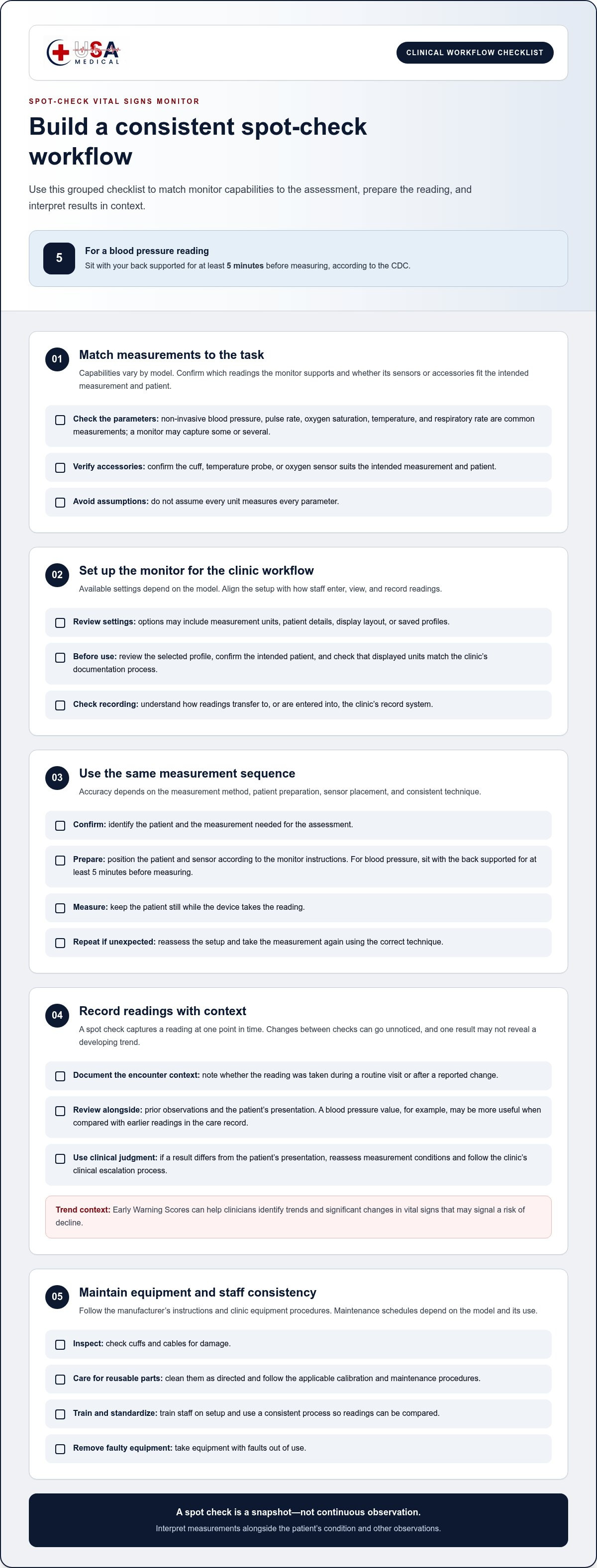
A spot check vital signs monitor supports a focused reading of selected measurements, rather than continuous observation. For a blood pressure reading, sit with your back supported for at least 5 minutes before measuring, according to the Centers for Disease Control and Prevention. Consistent measurement technique helps clinic teams interpret readings in context.
Clinic teams need equipment suited to the measurements and workflow involved in routine care. This guide explains how a spot check vital signs monitor captures readings, which measurements and settings may vary by model, and how results can inform care decisions. It also explains how Early Warning Scores can help clinicians identify trends and significant changes that may signal a risk of decline.
Key Takeaways
- Match monitor measurements and configurable features to the clinic’s care workflow and the readings staff need to capture.
- Use consistent measurement technique and interpret readings alongside patient context, not as isolated values.
- Understand how measurement method, patient factors, and device use can affect spot-check accuracy.
- Compare equipment by its intended use and capabilities, and weigh those needs when considering cost.
- Choose between spot checks and continuous monitoring based on whether episodic readings or ongoing observation better fits the care setting.
Configurable monitor features and measurements
A spot check vital signs monitor can bring several measurements into one workflow, but its capabilities depend on the model. Start by listing the readings staff need for routine assessments, then compare those requirements with the monitor’s supported measurements and setup options.
Common measurements include non-invasive blood pressure, pulse rate, oxygen saturation, temperature, and respiratory rate. A monitor may capture some or several of these, depending on its supported sensors and accessories. For example, a rooming workflow might begin with blood pressure and pulse, then include oxygen saturation when needed. Don’t assume every unit measures every parameter.
Settings can affect how staff enter, view, or record readings. Depending on the model, options may include measurement units, patient details, display layout, or saved profiles. These settings can help align the device with clinic routines. Before use, staff can review the selected profile, confirm the intended patient, and check that the displayed units match the clinic’s documentation process.
- Measurements: Match each needed parameter, such as blood pressure or temperature, to a supported measurement method.
- Accessories: Confirm that the cuff, temperature probe, or oxygen sensor fits the intended measurement and patient.
- Workflow: Set up patient entry and result display so staff can record readings consistently.
- Documentation: Review how readings transfer or are entered into the clinic’s record system.
Follow the monitor manufacturer’s instructions and the clinic’s equipment procedures for calibration and maintenance. The schedule depends on the model and its use. Routine care can include checking cuffs and cables for damage, cleaning reusable parts as directed, and removing faulty equipment from use.
A spot check captures readings at one point in time, so changes between checks can go unnoticed and a single result may not reveal a developing trend. Motion, an incorrectly fitted cuff, or a poorly positioned sensor can also affect a reading. Staff should repeat an unexpected measurement using the correct setup and interpret it alongside the patient’s condition.
Configuration is most useful when it supports the assessment without adding unnecessary steps. A clinic focused on blood pressure checks, for example, may prioritize a suitable cuff range and a clear display. A broader general-care workflow may require several supported measurements. Review the device instructions, train staff on setup, and use a consistent process for comparable readings.
Vital-sign monitoring for general care
General-care readings help teams assess a patient at a specific point in an encounter. Use a consistent technique and consider patterns across observations.
Requirements and Costs in the United States
In the United States, applicable FDA requirements depend on a monitor’s classification and intended use. Clinics should review the device labeling and regulatory documentation in relation to the planned measurements and care setting. This helps align procurement decisions with the monitor’s stated clinical purpose without assuming that every device has the same requirements.
A monitor’s cost depends on its capabilities and the equipment needed for the clinic’s workflow. A unit that supports more measurements may require different accessories or setup than one intended for a narrower task. Compare supported measurements, included components, documentation features, and ongoing supply needs to understand differences between options, rather than relying on price alone.
For general care, start with the decisions staff need the equipment to support. For routine visits, clear readings and straightforward recording may be priorities. When teams track changes over time, they may value a workflow that makes earlier observations easy to review alongside current results. Choose equipment for the task, not for functions the clinic won’t use.
Accuracy and Correct Use
Accuracy depends on the measurement method, patient preparation, correct sensor placement, and consistent technique. Early Warning Scores can help clinicians identify trends and significant changes in vital signs, and recognize when a patient may be at risk of decline. A single reading is a snapshot; comparing observations can provide useful context.
For a blood pressure measurement, sit with your back supported for at least 5 minutes before measuring, according to the Centers for Disease Control and Prevention (CDC). This preparation supports a more consistent reading. Record the result with the encounter context, such as whether it was taken during a routine visit or after a reported change.
Use a repeatable sequence for each assessment:
- Confirm the patient and the measurement needed for the assessment.
- Prepare the patient and position the sensor according to the monitor instructions.
- Keep the patient still while the device takes the reading.
- Record the result and review it alongside prior observations and the patient’s presentation.
For example, a blood pressure value may be more useful when staff can compare it with earlier readings in the same care record. If a result differs from the patient’s presentation, reassess the measurement conditions and follow the clinic’s clinical escalation process. Spot checks support general care, but readings should inform assessment, not replace clinical judgment.
How accurate are spot-check vital signs monitors?
Accuracy depends on the measurement, device, patient, and conditions during the reading. Blood pressure and oxygen saturation use different sensors, so one general accuracy label cannot describe every measurement. Review the device information for each parameter the clinic plans to use. A spot check vital signs monitor is most useful when staff follow its instructions and interpret readings as part of the patient’s assessment.
For blood pressure, cuff fit and placement affect the result. A cuff that does not suit the patient’s arm can produce a reading that is difficult to interpret. Staff should select a cuff within the specified range and position it as instructed. Using the same method for follow-up readings makes comparisons more meaningful.
Oxygen saturation readings depend on sensor placement and a stable measurement. Movement or a loose sensor can affect the reading. Staff should position the sensor as directed and allow the monitor to settle before recording the result. If the displayed value does not align with the patient’s presentation, reassess the setup and measurement.
Temperature results also depend on the probe and measurement site. An oral measurement, for example, requires the correct probe and positioning. Follow the device instructions, and record the site when that context is needed for later comparison. A result without its measurement context may be harder to interpret alongside another reading.
Accuracy also depends on how staff use results over time. A spot check captures one moment, while repeated observations can reveal a changing pattern. Early Warning Scores can help clinicians identify trends and significant changes in vital signs, and recognize when a patient may be at risk of decline. These scores add context to assessment rather than replacing it.
- Review each parameter: Assess device information for every measurement the clinic intends to use.
- Use compatible accessories: Match the cuff, probe, or sensor to its intended measurement.
- Keep technique consistent: Follow the same setup steps when readings need comparison.
- Interpret in context: Consider the patient’s presentation and other observations alongside the displayed result.
Routine equipment checks also support consistent readings. Follow the manufacturer’s instructions for inspection and cleaning. Remove a monitor from use if a cuff, cable, display, or sensor is damaged, or if staff cannot reproduce a reading using the correct method. Documenting equipment concerns helps the clinic track follow-up.
If a blood pressure result seems inconsistent with the patient’s presentation, for example, staff can review cuff fit and positioning before repeating it. Compare the new result with relevant observations instead of treating one display as a complete clinical picture. A spot check vital signs monitor provides a measurement; sound interpretation depends on the measurement conditions and the broader assessment.
Cost of spot-check vital signs monitors in the US?
The purchase cost of a spot check vital signs monitor depends on its configuration, included accessories, and intended workflow. A device for blood pressure alone differs from one supporting several measurements. Compare options with the readings staff need instead of selecting functions the clinic won’t use. The final equipment list should reflect routine tasks and patient needs.
Start by listing the measurements required during clinic visits. One workflow may focus on blood pressure, while another may also require temperature or oxygen saturation. Each measurement depends on compatible equipment, such as a probe or sensor. Review what each configuration includes and what must be purchased separately. Comparing complete setups gives procurement staff a clearer basis for evaluating options.
Accessories can shape the purchasing plan. A clinic may need cuffs suited to its patients or a temperature probe for its intake process. Identify the components required for each task before comparing devices. Assess a spot check vital signs monitor as part of a working setup, not just as a standalone unit.
Consider the documentation workflow, too. Staff may need to enter patient details, view readings clearly, or record results in the clinic’s system. Similarly, for independent and retail pharmacies offering routine patient health screenings alongside prescription services, utilizing dedicated management platforms like Datascan Pharmacy Software helps ensure seamless recordkeeping. Review how each monitor supports those steps. A configuration that fits existing routines may avoid unnecessary work, while an unfamiliar process may require staff training or changes to intake procedures.
Use this planning sequence to compare options:
- List the measurements required for routine care.
- Identify compatible cuffs, probes, and sensors.
- Compare included components with the clinic’s equipment needs.
- Consider recurring supplies and cleaning processes.
- Assess the display and documentation workflow for staff use.
Ownership planning should account for ongoing equipment needs. Care for reusable components according to their instructions, and plan for replacing damaged cuffs, cables, or probes. Include these practical considerations when comparing configurations. A lower-cost setup may not suit the intended workflow if it lacks an essential accessory.
A clinic measuring blood pressure can compare setups based on that task and its required cuffs. A clinic recording several measurements per visit should assess the complete configuration and its accessories. Compare equipment designed for equivalent needs so the decision reflects setup differences, not unrelated capabilities.
Use the manufacturer’s documentation to identify compatible components and care instructions. Then compare each complete setup with the clinic’s planned measurements and purchasing criteria. This helps assess a spot check vital signs monitor by the equipment and workflow it supports, rather than relying on a headline price alone.
How does a spot-check monitor compare with a continuous patient monitor?
A spot check monitor takes measurements when staff begin an assessment. A continuous patient monitor collects measurements over time while the patient remains connected. This difference shapes how each device fits into clinic care. Staff might use spot checks during routine rooming, while continuous monitoring supports observation when ongoing changes matter.
With spot checks, staff choose when to measure and which readings to capture. A clinic might record blood pressure and pulse during a scheduled visit, then repeat measurements if the patient’s condition changes. Each result represents the time it was taken. Changes between readings are not captured directly, so staff rely on assessment and the clinic’s observation process.
Continuous monitoring provides ongoing observations rather than separate snapshots. This can help staff follow changes during a period of active observation. The monitor, sensors, and patient connection remain part of the workflow, so staff need to manage positioning and keep the equipment in place. Continuous readings also require interpretation in context, since movement or sensor placement can affect displayed results.
Neither approach replaces clinical judgment. Spot checks can suit routine assessments that need a measurement at a particular point. Continuous monitoring is relevant when ongoing observation is part of the care plan. The decision depends on the patient’s needs, care setting, and what staff must observe, not simply on which device records more readings.
- Timing: Spot checks are initiated at selected moments; continuous monitoring follows measurements over time.
- Workflow: Spot checks involve brief measurement steps; continuous use requires ongoing patient connection and equipment oversight.
- Information: Separate readings show individual results; a continuous record can show changes between observations.
- Use: Match the monitoring method to the assessment and the level of observation required.
During a routine clinic visit, staff may take a blood pressure reading while rooming the patient and another measurement if the assessment calls for it. That is an episodic workflow. Where a clinician needs to observe changing measurements, continuous monitoring provides information between staff-led checks. The two approaches address different operational needs.
To compare equipment, identify the measurements required, how often staff need to review them, and whether the patient needs ongoing observation. Then consider setup, patient movement, documentation, and staff review. These practical factors help determine whether a spot check vital signs monitor or continuous equipment better suits the intended use.
Explore vital signs monitoring equipment to review options for clinic workflows.
USA Medical and Surgical Supplies: Blood Pressure Devices
USA Medical and Surgical Supplies offers Blood Pressure Devices for clinics selecting equipment for routine blood pressure measurements. Browse this category when reviewing your team’s blood pressure assessment needs alongside the monitoring approach described above. Consider how staff will use the device, who will take readings, and how results fit into your clinic’s workflow.
For broader diagnostic equipment needs, the available offerings also include Dopplers, ECG Machines, and ECG Electrodes. Focus your purchase on the measurements and tasks your team needs to support, rather than assuming one device serves every monitoring purpose.
Visit USA Medical and Surgical Supplies to explore Blood Pressure Devices.
Build a Monitoring Plan That Fits Your Clinic
Choosing a spot check vital signs monitor is part of a broader workflow decision. Before purchasing, define how readings will be used, who will record them, and how staff will respond when results warrant closer attention. A clear process connects equipment selection with daily clinic practice and patient assessment. It also gives your team a shared basis for training and consistent use.
USA Medical and Surgical Supplies offers Blood Pressure Devices, Dopplers, and ECG Machines for teams reviewing diagnostic equipment needs. Browse the category that fits your clinic’s next equipment requirement, then align your choice with staff tasks and the way your clinic documents care.
For help exploring the available equipment, contact USA Medical and Surgical Supplies. Start by identifying the measurements and tasks your team needs to support. That practical first step can help shape an informed equipment decision and a monitoring process suited to your care setting.
Frequently Asked Questions
What does spot-check monitoring do?
A spot check vital signs monitor takes selected readings during an assessment rather than tracking measurements continuously. During a follow-up visit, for example, a clinician can record the patient’s current readings and compare them with the visit notes. This provides a point-in-time measurement for the care record; changes between assessments require separate observation or another measurement.
Which vital signs can spot-check monitors measure?
Depending on the device, measurements may include blood pressure, pulse rate, oxygen saturation, temperature, and respiratory rate. The combination varies by monitor. A clinic’s intake checklist may require blood pressure and temperature, while another assessment may call for oxygen saturation. Before adding a device to a standard workflow, match its supported measurements and accessories to the planned tasks.
What features should I look for in a spot-check monitor?
Choose features that fit the clinic’s measurement and recording process. For a spot check vital signs monitor, consider whether staff can read the display easily, operate the controls consistently, and use suitable accessories for the planned measurements. If results need to be entered in a separate record, include that step in a workflow trial. Walking through a typical visit can reveal practical gaps.
How often should spot-check monitors be calibrated and maintained?
Follow the monitor manufacturer’s instructions and the clinic’s equipment procedures; the schedule depends on the model and its use. Routine care can include checking cuffs and cables for damage, cleaning reusable parts as directed, and removing faulty equipment from use.
Which spot-check vital signs monitors are best for clinics and hospitals?
Choose a monitor whose supported measurements, accessories, and setup fit the clinic’s workflow and care needs. Compare its capabilities and documentation features, and make sure staff can use it consistently.