
Selecting the Right Blood Pressure Monitor: 2026 Clinical Buying Guide
09/25/2026 12:28:28
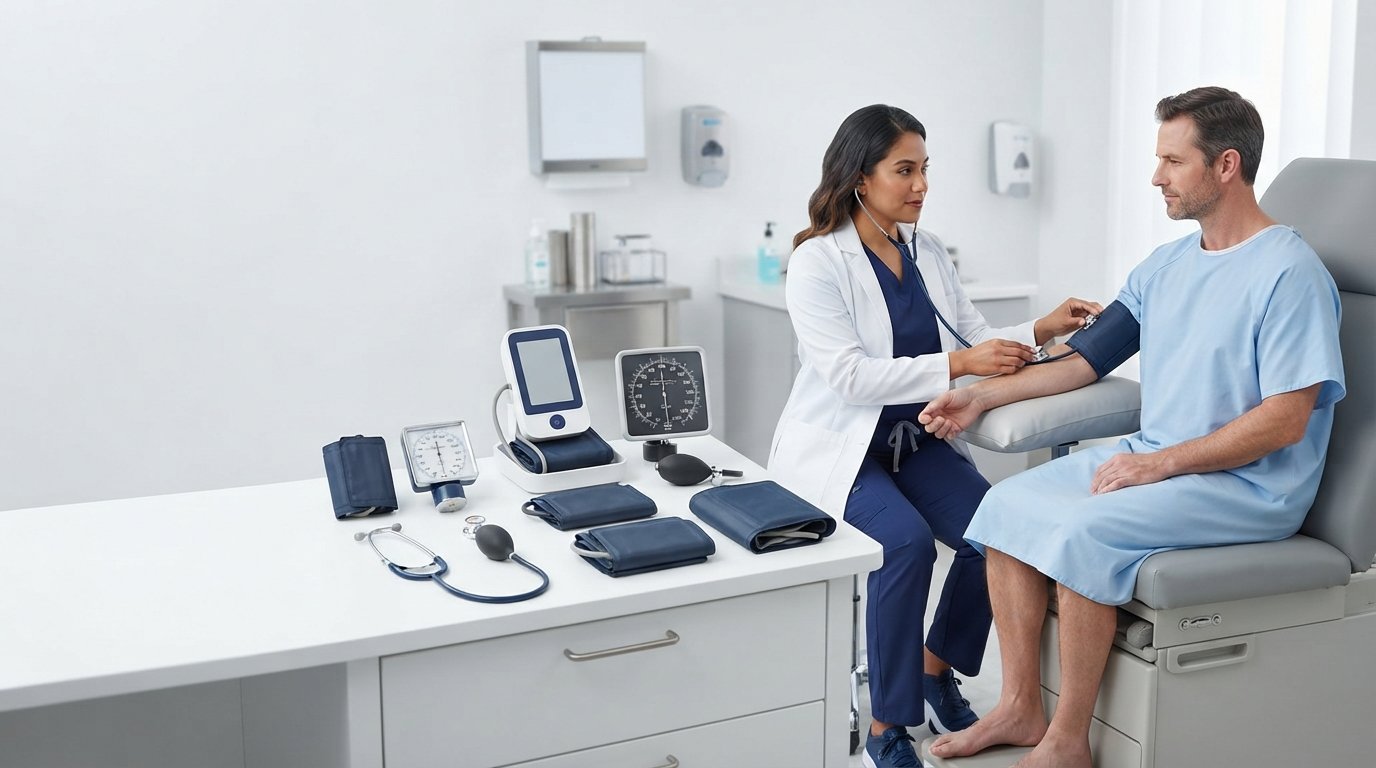
Digital convenience does not guarantee diagnostic precision. A sleek mobile dashboard means very little if an unverified sensor misreads arterial pressure. Selecting a dependable blood pressure monitor requires looking past consumer gadgets and prioritizing foundational clinical utility. If you've struggled with inconsistent readings across different units, confused cuff sizing charts, or uncertain artery alignment, you're dealing with an all-too-common challenge. Inaccurate screening data undermines clinical confidence, risks false diagnoses, and disrupts structured care plans.
True diagnostic reliability comes down to recognized testing protocols and sound mechanical design, not retail novelties. In this 2026 buying guide, you'll learn how to evaluate independent clinical validation credentials, verify bladder dimensions, and compare automated oscillometric sensors with manual auscultatory instruments to select the ideal setup. We'll examine the technical criteria that separate diagnostic-grade tools from generic consumer units, outline proper cuff fit requirements, and establish clear standards to ensure dependable, repeatable measurements across patient care and routine home monitoring.
Key Takeaways
- Learn how independent validation standards such as AAMI, ESH, and ISO differentiate verified diagnostic instruments from inconsistent consumer-grade gadgets.
- Compare automated oscillometric sensors with manual auscultatory sphygmomanometers to select the ideal blood pressure monitor for your specific clinical workflow.
- Master anatomical cuff sizing protocols to eliminate the systematic overestimation and underestimation errors that distort patient baseline data.
- Plan multi-year equipment lifecycle maintenance by establishing regular calibration verification schedules and identifying key replacement components before mechanical failure occurs.
Clinical Blood Pressure Monitor Categories: Diagnostic Mechanisms and Primary Applications
At its core, a clinical blood pressure monitor serves a clear mechanical purpose: safely occluding an artery and measuring pressure variations during controlled deflation. Healthcare facilities, diagnostic practices, and home caregivers generally select between two distinct operational formats: automated oscillometric units and manual acoustic sphygmomanometers. Selecting the right platform depends on patient volume, examiner training, and vascular health. International validation standards ensure that whether a clinic utilizes manual or electronic equipment, baseline readings remain accurate across diverse demographics and clinical settings.
Automated Digital Upper-Arm Monitors
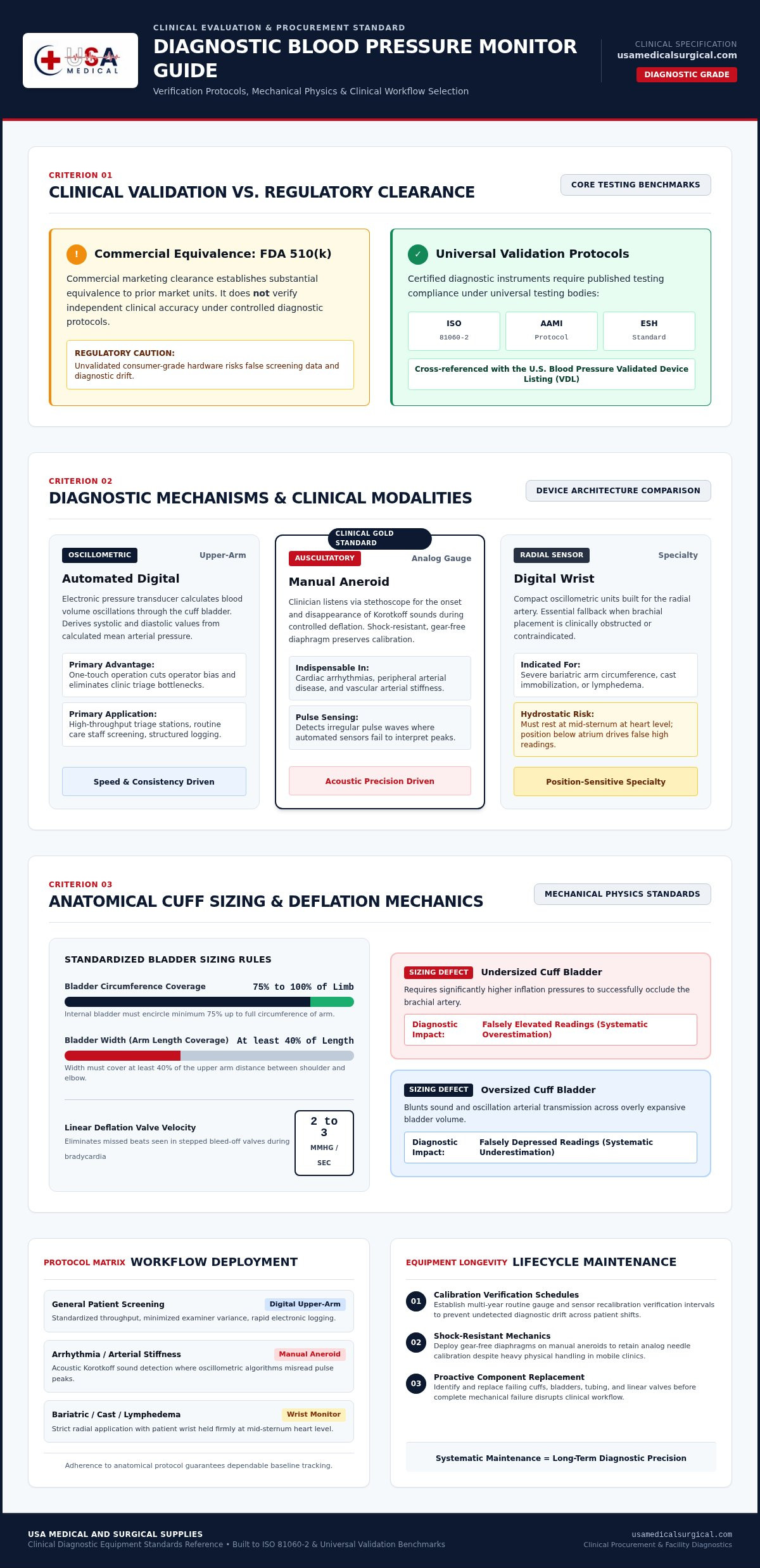
Digital upper-arm systems use an electronic pressure transducer to measure blood volume oscillations through the cuff bladder. The device's internal algorithm identifies peak oscillation amplitude to determine mean arterial pressure, deriving systolic and diastolic numbers from that baseline. These digital systems deliver consistent speed during high-throughput triage and structured patient logging. One-touch operation cuts down on operator bias, minimizes clinic bottlenecks, and simplifies routine screening protocols for everyday care staff.
Manual Aneroid Sphygmomanometers
Manual aneroid units rely on the traditional auscultatory technique. A clinician inflates the cuff, slowly releases the air valve, and listens through a stethoscope for the onset and disappearance of Korotkoff sounds against an analog needle gauge. Manual auscultation remains the clinical gold standard for patients presenting with cardiac arrhythmias, peripheral arterial disease, or vascular stiffness. In these scenarios, digital oscillometric sensors often fail to detect distinct pulse waves. Modern clinical aneroids feature shock-resistant, gear-free diaphragms that retain calibration across demanding mobile clinic shifts.
Digital Wrist and Specialty Portable Devices
Wrist monitors incorporate compact oscillometric sensors configured for the radial artery. These specialized tools offer an essential alternative when upper-arm placement is impossible due to severe bariatric arm circumference, cast immobilization, or lymphedema. However, wrist sensors are highly sensitive to hydrostatic pressure shifts. Placing the device even a few inches below the right atrium introduces immediate hydrostatic error, falsely driving up readings. Reliable screening requires strict adherence to posture standards, keeping the patient's wrist rested directly against the mid-sternum at heart level.
Core Technical Criteria for Evaluating Diagnostic Accuracy
Diagnostic accuracy rests on measurable engineering parameters, not digital app add-ons. Clinical facilities and caregivers must evaluate physical sensor mechanics and testing certifications before deploying any blood pressure monitor. Understanding these benchmarks ensures that baseline cardiovascular records reflect genuine physiological status rather than equipment error.
Recognized Clinical Validation Standards
Marketing clearance does not equal diagnostic validation. An FDA 510(k) clearance primarily establishes substantial equivalence to existing commercial devices. It does not certify independent clinical accuracy under rigorous testing conditions. Clinical procurement teams look for compliance with ISO 81060-2 protocols and the universal validation standards established by AAMI and ESH. Resources such as the U.S. Blood Pressure Validated Device Listing (VDL) track independently verified hardware. Using non-cleared consumer gadgets carries severe diagnostic hazards, a point reinforced by the FDA warning on unauthorized monitors.
Cuff Bladder Dimensions and Inflation Mechanics
Mechanical errors stem frequently from mismatched bladder physics. A clinically sound internal bladder must encircle 75% to 100% of the limb circumference and cover at least 40% of the upper arm length. Undersized cuffs require higher inflation pressures to occlude the brachial artery, generating falsely elevated readings. Oversized cuffs blunt arterial transmission, causing underestimation. Furthermore, linear deflation valves that release air smoothly at 2 to 3 mmHg per second provide far greater accuracy than basic stepped bleed-off valves, which often skip beats during patient bradycardia.
Sensor Capabilities and Arrhythmia Detection
Modern oscillometric processors filter out somatic tremors, coughing, and minor motion artifacts to isolate true arterial pulses. Integrated irregularity indicators alert staff to irregular pulse intervals during inflation cycles. Multi-reading averaging modes automatically take three spaced readings and average the results, neutralizing white-coat spikes. Teams seeking long-term diagnostic durability can review verified clinical blood pressure devices engineered to maintain sensor precision across demanding daily shifts.
Manual vs. Digital Blood Pressure Devices: Workflow and Setting Comparison
Choosing between manual aneroid sphygmomanometers and automated digital systems depends on clinical throughput, operator proficiency, and patient characteristics. Manual tools offer superior diagnostic flexibility for experienced clinicians, whereas automated systems standardize intake screening across varying skill levels. Balancing both platforms ensures that operational speed doesn't compromise diagnostic accuracy.
Clinical Facility and Outpatient Workflows
Outpatient clinics processing dozens of patients daily prioritize intake velocity. Automated digital devices capture readings in under forty seconds, freeing staff to chart symptoms or collect baseline history. These systems eliminate parallax error, which occurs when a provider views an analog needle dial from an improper angle. They also prevent auditory fatigue during long shifts in noisy clinical bays. Even so, practices still rely on manual units alongside a stethoscope to verify irregular rhythm flags or acute hypertensive crises. Reviewing the CDC guide to accurate blood pressure measurement helps staff establish uniform resting and cuff-placement protocols across every exam lane.
Home Health and Patient Self-Monitoring
Patients tracking hypertension independently rarely achieve accurate readings with manual equipment. Pumping an inflation bulb with one hand while balancing a stethoscope chestpiece causes isometric muscle contraction, which artificially inflates systolic numbers. A validated digital blood pressure monitor removes this mechanical obstacle through automated one-touch inflation. Onboard memory storage captures day-to-day readings, giving physicians a dependable record for telemedicine reviews without relying on handwritten logs. Beyond tracking daily cardiovascular vitals, individuals focusing on long-term health often explore at-home modalities to manage systemic inflammation; read more about molecular hydrogen technology designed for personal wellness.
Environmental and Mechanical Durability
Durability profiles differ substantially between delicate analog mechanisms and electronic casings. Traditional aneroid gauges use sensitive copper-beryllium diaphragms that can easily drift out of alignment if dropped. Clinicians must inspect the needle baseline regularly to confirm it rests within the zero-box indicator. Digital units handle physical handling well, but their internal sensors degrade if exposed to severe humidity or dropping battery voltages. Factoring in regular cuff replacements, tubing checks, and sensor maintenance ensures a dependable operational lifespan for any chosen blood pressure monitor.
Selecting the Correct Cuff Size and Establishing Standardized Measurement Protocols
Even the most advanced blood pressure monitor delivers misleading data if paired with the wrong cuff. Sizing discrepancies represent one of the most widespread sources of clinical diagnostic error. Undersized cuffs compress soft tissue unevenly, requiring excess air pressure to collapse the artery and driving systolic figures up by 8 to 10 mmHg. Oversized cuffs cause loose contact that dampens pulse wave energy, leading to systematic underestimation. Achieving diagnostic precision requires strict adherence to anatomical measurement and positioning standards.
Arm Circumference Measurement and Cuff Classification
Staff should determine cuff size using a flexible cloth tape measured at the midpoint between the acromion and the olecranon process. Never guess limb dimensions by sight alone. Selecting an appropriate cuff from standardized tiers ensures proper bladder coverage:
- Small Adult: 17 to 25 cm circumference
- Standard Adult: 23 to 33 cm circumference
- Large Adult: 31 to 40 cm circumference
- Bariatric / Thigh: 38 to 50 cm circumference
Once sized, wrap the cuff smoothly around the bare upper arm. Align the printed artery indicator arrow directly over the palpable brachial artery, positioning the lower cuff margin 2 to 3 cm above the antecubital fossa.
Standardized Measurement Preparation and Posture
Procedural consistency prevents artificial blood pressure spikes during intake screening. A dependable screening protocol follows five core rules:
- Allow the patient five minutes of silent rest before taking an initial reading.
- Confirm the patient has an empty bladder and hasn't consumed caffeine or nicotine in the preceding 30 minutes.
- Seat the patient upright with firm back support, feet flat on the floor, and uncrossed legs.
- Support the bare arm at mid-sternum height; never push a tight sleeve up the arm, as rolled fabric acts as an occlusive tourniquet.
- Maintain complete silence throughout the active inflation and deflation cycle.
Sanitization and Infection Prevention Protocols
Blood pressure cuffs touch dozens of patients daily, making routine surface disinfection mandatory between screenings. Wipe reusable vinyl, nylon, and thermoplastic polyurethane (TPU) cuffs with hospital-grade antimicrobial wipes, observing required surface wet times. For contact isolation wards and immunocompromised environments, switch to dedicated single-patient disposable cuffs to break the chain of cross-contamination. To equip your facility with standardized diagnostic gear, order clinical blood pressure devices and verified replacement cuffs built for daily infection control routines.
Procuring Reliable Blood Pressure Equipment: Sourcing and Long-Term Maintenance
Procuring diagnostic hardware is only the initial step in maintaining screening standards across a practice. Long-term accuracy requires planned quality assurance, timely replacement of pneumatic parts, and a dependable distribution partner. Without systematic upkeep, even a premium blood pressure monitor can quietly fall out of tolerance over months of routine operation.
Calibration Verification and Quality Assurance
Clinical standards recommend verifying manometer accuracy at least once every twelve months. Biomedical teams typically use a Y-connector testing apparatus to evaluate target devices against a calibrated reference standard across multiple pressure levels, such as 60, 120, 180, and 240 mmHg. For manual aneroid dials, inspect the resting needle before every shift. Any indicator resting outside the printed zero-box signifies internal gear or diaphragm damage, requiring immediate replacement. Maintaining thorough calibration documentation ensures ongoing compliance with facility accreditation standards and inspection guidelines.
Sourcing Compatible Replacement Accessories
High clinical volume inevitably causes mechanical wear on pneumatic accessories. Tubing lines stiffen, rubber inflation bulbs lose elasticity, and thumbscrew valves collect lint or strip threading over time. When stocking backup supplies, verify connector styles to ensure proper integration:
- Screw-type connectors: Provide secure threaded locking for mobile field units.
- Push-in luer locks: Enable rapid friction-fit cuff changes on shared monitors.
- Bayonet couplings: Deliver quarter-turn quick connects for high-throughput screening stations.
Stocking standardized, latex-free cuff assemblies prevents exam room downtime while eliminating patient allergy risks.
Streamlining Equipment Procurement for Practices and Caregivers
Equipping multiple exam rooms or residential care wings runs smoothest when sourcing stays centralized. Ordering single cuffs or replacement valves piecemeal introduces logistical delays, varying hardware standards, and higher shipping overhead. Consolidating orders across verified diagnostic devices, stethoscopes, and infection control supplies ensures uniform performance and simpler inventory control. Explore the comprehensive diagnostic catalog at USA Medical and Surgical Supplies to source dependable clinical instruments with efficient nationwide fulfillment.
Equip Your Facility with Confident Diagnostic Precision
Accurate cardiovascular screening depends on sound mechanical engineering, not consumer gimmicks. Diagnostic confidence requires choosing an independently validated blood pressure monitor, matching cuff bladders to limb anatomy, and following disciplined measurement protocols. Establishing annual calibration checks and replacing worn pneumatic components ensures your screening data remains clinically reliable year after year.
Streamlining clinical equipment procurement shouldn't create operational friction. As a dedicated national distributor of clinical-grade diagnostic instruments and consumables, USA Medical and Surgical Supplies maintains an extensive inventory spanning manual aneroid sphygmomanometers, automated digital units, and universal cuff assemblies. Practice teams and private caregivers can standardize care protocols with ease. Explore clinical blood pressure devices and diagnostic supplies at USA Medical and Surgical Supplies to support your screening requirements with dependable, verified instruments.
Frequently Asked Questions
How do I know if a digital blood pressure monitor is accurate?
Check independent clinical validation registries such as the U.S. Blood Pressure Validated Device Listing (VDL) or look for ISO 81060-2 compliance. An FDA clearance alone doesn't guarantee accuracy under clinical testing protocols. You can also bring your digital blood pressure monitor to a clinical office to cross-reference readings against a calibrated sphygmomanometer. Consistent resting posture, verified cuff fit, and zero movement remain critical to verifying sensor accuracy.
What is the difference between an aneroid and a digital blood pressure monitor?
Aneroid monitors require manual auscultation, where a clinician inflates the bladder and listens to Korotkoff sounds using a stethoscope and mechanical gauge. Digital monitors rely on oscillometric pressure transducers that calculate mean arterial pressure automatically. Manual devices provide superior diagnostic utility for patients with arrhythmias or arterial stiffness, while digital systems accelerate outpatient triage and eliminate the technical learning curve for home self-monitoring.
How do I choose the correct cuff size for my blood pressure device?
Measure your bare mid-upper arm circumference using a flexible measuring tape halfway between the shoulder and elbow. Match that measurement to the manufacturer's range printed on the cuff. A correct bladder should cover 75% to 100% of the arm's circumference. Avoid guessing size based on clothing fit; undersized cuffs falsely elevate systolic readings, while oversized cuffs lead to underestimation.
Why do blood pressure readings fluctuate between consecutive measurements?
Arterial pressure naturally shifts from minute to minute due to breathing, talking, body movement, and emotional state. In addition, repeating a measurement without resting can trap venous blood in the forearm, distorting the subsequent reading. Always rest quietly for five minutes before testing, sit with your back supported and arm at heart level, and wait at least two minutes before initiating a second reading.
Can wrist blood pressure monitors be used interchangeably with upper arm monitors?
No, wrist monitors shouldn't be used interchangeably with upper arm monitors for standard screening. Wrist sensors are exceptionally sensitive to hydrostatic pressure variations. If the wrist sits even two inches below mid-sternum level, readings skew noticeably higher. Upper-arm devices remain the diagnostic standard, while wrist units serve primarily when arm circumference, lymphedema, or clinical trauma prevents upper-arm placement.
How often does a clinical blood pressure monitor need to be calibrated?
Clinical facilities should perform calibration checks on every clinical blood pressure monitor at least once every twelve months. Units used in mobile emergency kits or high-impact outpatient wings benefit from semi-annual testing. For manual aneroid gauges, visually inspect the dial before every shift; if the needle doesn't rest completely inside the designated zero-box, remove the instrument from service.
What does the irregular heartbeat or arrhythmia indicator mean on my monitor?
This alert indicates that the internal sensor detected pulse wave intervals that varied by more than 25% from the median rhythm during measurement. Somatic muscle movement, coughing, or talking during cuff deflation frequently triggers false flags. If this icon appears consistently across multiple calm resting sessions, present the screening log to a clinician for dedicated diagnostic testing, such as an electrocardiogram.